Designing a userfriendly device to restore hand function after spinal cord lesion or stroke
Background
 Accidents like cervical spinal cord injury (e.g. after
breaking the neck) or an ictus can lead to paralysis of the arm and hand. In
many cases this paralysis is partial, such that for example some wrist movement
is possible but the fingers cannot be used. The wrist movement can be measured
by electrodes on the skin of the forearm as myoelectric signals (MES). Fingers
can be stimulated to extension or flexion by electrical stimulation of the
muscle nerves (FES), likewise via electrodes on the forearm.
It has been clinically demonstrated that MES can be used to
control FES to restore handfunction using a specialized electronic device.
Currently the prototypes are pocket size and battery powered. Electrodes are
self adhesive pads that must be placed on the skin at certain subject dependent
spots on the forearm. These are connected with the electronics using wires.
Clinical studies have shown feasibility of the
system and that it can be applied by therapists and patients as is to
achieve functional benefits.
Accidents like cervical spinal cord injury (e.g. after
breaking the neck) or an ictus can lead to paralysis of the arm and hand. In
many cases this paralysis is partial, such that for example some wrist movement
is possible but the fingers cannot be used. The wrist movement can be measured
by electrodes on the skin of the forearm as myoelectric signals (MES). Fingers
can be stimulated to extension or flexion by electrical stimulation of the
muscle nerves (FES), likewise via electrodes on the forearm.
It has been clinically demonstrated that MES can be used to
control FES to restore handfunction using a specialized electronic device.
Currently the prototypes are pocket size and battery powered. Electrodes are
self adhesive pads that must be placed on the skin at certain subject dependent
spots on the forearm. These are connected with the electronics using wires.
Clinical studies have shown feasibility of the
system and that it can be applied by therapists and patients as is to
achieve functional benefits.However, solving some design issues will beyound doubt make the system more userfriendly and functional; thus more successful as a product.
An electrode mount for facilitating donning and doffing in autonomy
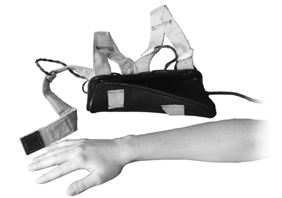
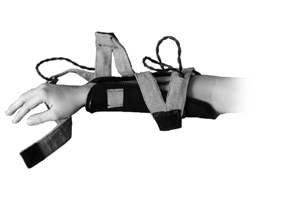
The only similar device is the former Handmaster, now H200 from Bioness.
Further development of the designs should go in the direction of minimization of visual impact and production cost.